Canadian homeowners are becoming more thoughtful about how they renovate their homes.
A renovation is no longer only about making a property look newer. Homeowners are increasingly considering comfort, energy use, functionality, long-term maintenance, technology, accessibility, and the future needs of their families.
This shift is creating new opportunities for contractors.
The latest Canadian Renovation Trends show growing interest in improvements that make homes more comfortable, efficient, adaptable, and easier to manage. At the same time, homeowners still want attractive kitchens, bathrooms, finished basements, outdoor spaces, and personalised interiors.
According to the 2026 Canada Mortgage and Housing Corporation (CMHC) Mortgage Consumer Survey, 63% of mortgage consumers said they planned to renovate within the next five years. Among homeowners planning renovations, 46% expected to spend at least $20,000. CMHC also found that 29% planned to renovate to improve energy efficiency.
That creates an important opportunity for renovation contractors.
But there is a difference between a renovation that looks impressive and one that provides lasting value.
The best projects often combine both.
A smart thermostat, for example, may not have the visual impact of a new kitchen. However, when combined with better insulation, efficient heating, improved windows, and thoughtful automation, it can contribute to a more comfortable and efficient home.
This article explores the major Canadian Renovation Trends contractors and homeowners should understand, including smart technology, energy efficiency, luxury design, custom renovation projects, and practical improvements that can support long-term property value.
What Makes a Renovation a Smart Investment?
Return on investment, or ROI, is often discussed when people plan a renovation.
However, homeowners should be careful about assuming that every renovation will return its full cost when the property is sold.
Renovation value depends on many factors, including location, property type, workmanship, materials, market conditions, buyer preferences, and the overall condition of the home.
A better approach is to consider total value.
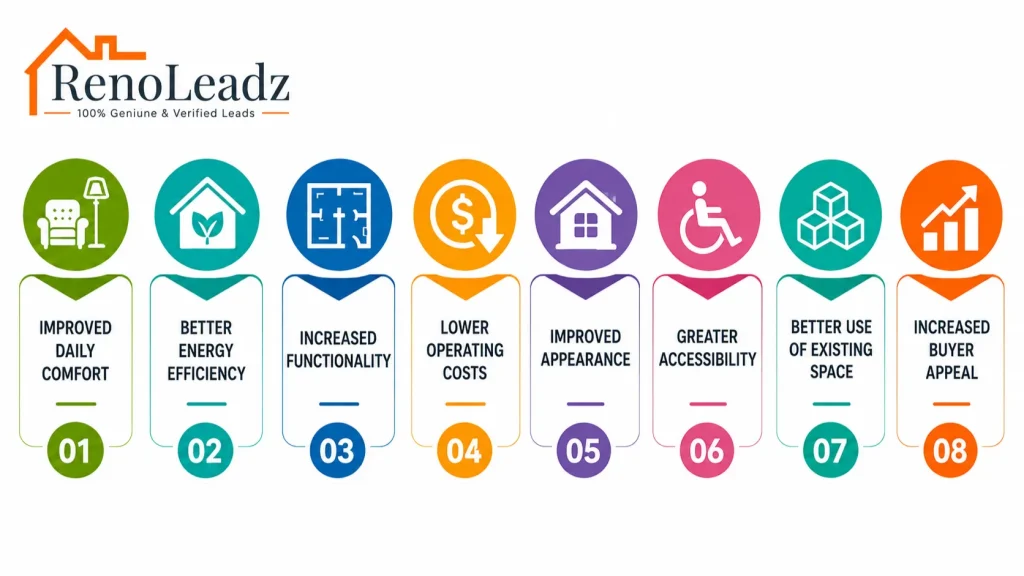
A successful renovation can provide value through:
- Improved daily comfort
- Better energy efficiency
- Increased functionality
- Lower operating costs
- Improved appearance
- Greater accessibility
- Better use of existing space
- Increased buyer appeal
The strongest projects often solve a real problem while improving the home’s appearance.
That principle is behind many of the most important Canadian Renovation Trends emerging today.
1. Smart Energy-Efficient Upgrades
Energy efficiency is one of the clearest renovation trends in Canada.
Canadian homeowners have to deal with different climates, seasonal temperature changes, and rising expectations for home comfort. As a result, improvements that reduce energy waste can have practical value beyond appearance.
CMHC’s 2026 research found that 29% of mortgage consumers planned renovations to improve energy efficiency. Among those planning energy-efficiency renovations, 43% planned to add new doors or windows and 37% planned to seal areas of air leakage.
These improvements can include better insulation, air sealing, efficient windows, upgraded doors, heating systems, and smart controls.
The important point for homeowners is that energy efficiency should be considered as a system.
Replacing one component may help, but the greatest benefit may come from combining several improvements.
For contractors, this creates an opportunity to educate homeowners rather than simply selling individual products.
A contractor can explain how insulation, windows, air sealing, ventilation, and heating work together to improve the home.
That type of expertise can strengthen trust and help differentiate a professional contractor from a company competing mainly on price.
2. Smart Heating and Cooling Systems
Heating and cooling are major parts of home comfort in Canada.
Smart thermostats and efficient heating and cooling equipment can help homeowners manage temperature settings more effectively.
Heat pumps are also receiving significant attention as an energy-efficient heating and cooling option. Natural Resources Canada reported that more than 286,000 heat pumps had been installed with federal support since December 2020 as of March 2026.
Smart controls can also help homeowners understand and manage how their homes use energy.
However, contractors should avoid presenting any technology as a guaranteed way to save a specific amount of money.
Actual savings depend on the home, equipment, climate, usage, installation, energy prices, and other factors.
A professional contractor should assess the property before recommending major mechanical or electrical upgrades.
This is especially important for custom home renovation projects, where new technology may need to work with existing electrical, HVAC, insulation, and building systems.
3. Energy-Efficient Windows and Doors
Windows and exterior doors can have a major effect on comfort and energy performance.
Older windows may contribute to drafts, heat loss, condensation, and uneven indoor temperatures.
Replacing them with appropriate energy-efficient products can improve comfort while updating the appearance of a property.
Natural Resources Canada lists ENERGY STAR-certified windows and doors among eligible energy-efficiency retrofit measures under applicable programmes.
For contractors, this is another area where education matters.
Homeowners should understand that window performance is not determined by appearance alone. Factors such as glazing, frame material, installation quality, orientation, and overall building performance can influence results.
A professional installation is just as important as selecting the right product.
This is a useful message for marketing for renovation companies because it demonstrates expertise rather than simply promoting a product.
4. Smart Lighting and Home Automation
Smart home technology is becoming easier to integrate into renovation projects.
Homeowners can now use connected systems for lighting, temperature control, security, entertainment, and other functions.
However, the best smart homes are not necessarily the ones with the largest number of devices.
Good design is about making technology useful.
For example, a renovation could include:
- Automated lighting scenes
- Smart thermostats
- Motion-sensitive lighting
- Connected security systems
- Smart blinds
- Home entertainment controls
- Energy monitoring
The goal should be convenience without creating unnecessary complexity.
During a renovation, wiring and electrical planning should be considered early. Adding smart features after walls are finished can be more difficult and expensive than planning them during the design and construction stage.
This is one reason smart technology fits naturally into custom renovation projects.
Technology can be integrated into the overall design rather than added as an afterthought.
5. High-Performance Kitchens
The kitchen remains one of the most important renovation areas in many Canadian homes.
But modern kitchen renovations are moving beyond appearance.
Homeowners want kitchens that work better for everyday life.
That can mean improved storage, better lighting, durable surfaces, efficient appliances, larger work areas, and layouts that make movement easier.
A high-value kitchen renovation should begin with how the household actually uses the space.
A family that cooks frequently may need different solutions from a homeowner who primarily uses the kitchen for entertaining.
For a luxury home renovation, the focus may include custom cabinetry, premium appliances, stone surfaces, integrated technology, and specialised lighting.
However, luxury does not always mean adding the most expensive materials.
Good design means selecting features that make sense for the property and the homeowner.
This is an important principle for contractors targeting premium projects: quality, function, and design should work together.
6. Luxury Bathrooms With Practical Features
Bathrooms are another area where homeowners are combining design with comfort and functionality.
Modern bathroom renovations may include larger showers, improved storage, heated floors, better lighting, water-efficient fixtures, and accessible design features.
Luxury bathrooms can also include premium finishes and custom details.
However, a successful bathroom renovation should not focus only on visual appeal.
Ventilation, waterproofing, drainage, electrical work, lighting, and material selection are critical to long-term performance.
For a luxury home renovation, homeowners may be willing to invest more in high-quality finishes, but professional installation remains essential.
A beautiful bathroom that develops moisture problems later is not a successful renovation.
That is why experienced contractors should communicate both the design benefits and the technical considerations of the project.
7. Basement and Multi-Functional Living Spaces
Canadian homeowners are also looking for better ways to use the space they already have.
A basement can become much more than a storage area.
Depending on local requirements and the property, homeowners may use finished basements for:
- Home offices
- Entertainment rooms
- Guest areas
- Fitness spaces
- Playrooms
- Additional living areas
- Secondary suites
CMHC’s 2026 survey found that 16% of mortgage consumers planning renovations listed adding a secondary suite as a reason for renovating.
Secondary suites can involve important requirements related to building codes, fire safety, zoning, plumbing, electrical systems, and permits.
Contractors should therefore approach these projects carefully and make sure homeowners understand that requirements vary by municipality and project type.
The broader trend is clear: homeowners want their existing square footage to work harder.
This creates strong potential for custom renovation projects that improve the usefulness of underused spaces.
8. Custom Renovation Projects for Long-Term Value
Standard renovation packages may work for some homeowners, but custom projects are becoming increasingly important for properties with unique layouts, older construction, or specific lifestyle requirements.
A custom renovation can address problems that a standard solution cannot.
For example, a homeowner may want to:
- Reconfigure an outdated floor plan
- Improve natural light
- Combine kitchen and living areas
- Create a dedicated home office
- Add custom storage
- Improve accessibility
- Integrate smart technology
- Upgrade the building envelope
The value of a custom renovation is not simply the number of features added.
It comes from how well the project solves the homeowner’s actual needs.
This is where experienced contractors can stand apart.
A contractor who listens carefully, explains options, manages expectations, and delivers quality workmanship can provide much more value than one who simply installs materials.
9. Outdoor Living and Connected Home Features
Outdoor living remains relevant for Canadian homeowners who want to make greater use of their properties during warmer months.
Depending on the home and location, renovation projects may include decks, patios, outdoor kitchens, lighting, privacy features, landscaping integration, and covered spaces.
Technology can also extend outdoors.
Smart lighting, security systems, outdoor audio, and automated controls can make outdoor spaces more convenient.
However, outdoor renovation projects should be designed for the local climate.
Materials need to be selected based on weather exposure, moisture, temperature changes, maintenance requirements, and expected use.
A professional contractor should consider durability alongside appearance.
This is particularly important for luxury home renovation projects where homeowners may invest heavily in outdoor features.
10. Accessibility and Future-Ready Renovations
A renovation can also be an opportunity to prepare a home for changing needs.
Wider doorways, better lighting, safer bathrooms, easier access, improved circulation, and thoughtful floor plans can make homes more comfortable for people of different ages and abilities.
This is sometimes overlooked because accessibility is often viewed only as a response to an immediate need.
A better approach is to think about long-term usability.
A home that can adapt as household needs change may remain functional for longer.
Canada also has tax measures related to accessibility and multigenerational housing, although eligibility and requirements vary. Homeowners should confirm current rules with the appropriate government authority or a qualified tax professional.
For contractors, future-ready design can become a valuable part of a broader renovation consultation.
What Homeowners Should Know About Renovation ROI
There is no universal percentage that guarantees a particular renovation will return a specific amount.
A renovation’s financial return depends heavily on the property and local market.
For example, a modest kitchen upgrade may make more sense in one neighbourhood, while a high-end custom kitchen may be appropriate for a luxury property.
Homeowners should therefore consider three questions before starting a project:
- Does the renovation solve a real problem?
- Will the improvement remain useful for several years?
- Does the project make sense for the property and neighbourhood?
These questions help prevent over-improvement.
A renovation should fit the home.
That does not mean homeowners should avoid personal choices. It simply means major investments should be made with an understanding of the property’s market, condition, location, and long-term use.
What These Trends Mean for Contractors
The changing renovation market creates opportunities for contractors who can do more than complete construction work.
Homeowners increasingly need help understanding their options.
They may not know whether to upgrade insulation before replacing windows, whether a heat pump is appropriate for their property, how to plan smart-home wiring, or how to balance luxury finishes with practical improvements.
Contractors who can explain these decisions clearly can build stronger relationships with potential customers.
This is where content marketing becomes important.
A contractor’s website should answer real homeowner questions before the sales conversation begins.
Articles about renovation planning, energy efficiency, smart home technology, kitchen design, basement renovations, and luxury upgrades can demonstrate expertise.
This approach also supports marketing for renovation companies because useful content can attract homeowners through search engines and social media.
How Marketing for Renovation Companies Can Capture Demand
The renovation industry is competitive.
A contractor can have excellent workmanship but still struggle to generate enquiries if potential customers cannot find the business online.
Effective marketing for renovation companies should connect the contractor’s expertise with the questions homeowners are searching for.
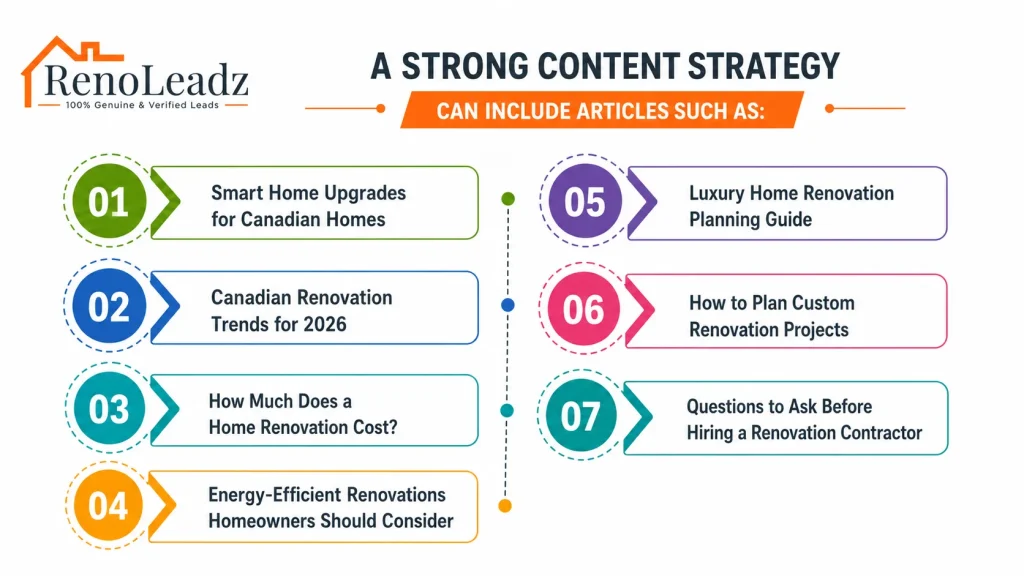
A strong content strategy can include articles such as:
- Smart Home Upgrades for Canadian Homes
- Canadian Renovation Trends for 2026
- How Much Does a Home Renovation Cost?
- Energy-Efficient Renovations Homeowners Should Consider
- Luxury Home Renovation Planning Guide
- How to Plan Custom Renovation Projects
- Questions to Ask Before Hiring a Renovation Contractor
These articles can then connect to service pages.
This creates a hub-and-spoke structure.
The main service or commercial page acts as the hub, while informational articles act as spokes that answer related questions.
The goal is not to repeat the same keyword in every article.
Instead, each article should have a clear purpose and search intent.
How Contractor Lead Generation Services Support Growth
Content and SEO can build long-term visibility, but contractors may also need a more direct way to generate opportunities.
This is where Contractor Lead Generation Services in Mississauga can complement organic marketing.
A lead generation strategy can help connect contractors with homeowners who are looking for renovation services.
For a contractor, the quality and relevance of an opportunity matter.
A useful lead should ideally match important criteria such as:
- Location
- Project type
- Timing
- Budget potential
- Contact information
- Service requirements
The more closely a lead matches the contractor’s ideal customer, the more useful the opportunity can be.
This is why RenoLeadz focuses on renovation and home improvement lead generation.
The objective is not simply to create a large number of enquiries. Contractors need opportunities that fit the services they actually provide and the markets they can serve.
Contractors should also evaluate lead generation providers carefully. Ask how leads are sourced, what information is supplied, which locations are covered, and whether opportunities are exclusive or shared.
Transparent expectations are essential.
Common Renovation Mistakes to Avoid
Even strong renovation ideas can become poor investments if the project is not planned correctly.
One common mistake is focusing too heavily on appearance while ignoring the home’s underlying systems.
Another is choosing materials based only on price.
Poor planning can also lead to unexpected changes, delays, and additional costs.
Homeowners should also avoid assuming that every online renovation trend will suit their property.
A smart renovation starts with the home, not the trend.
Before beginning a major project, homeowners should understand the scope, budget, timeline, permits, materials, and responsibilities involved.
Contractors can help by providing clear documentation and realistic expectations from the beginning.
Conclusion
The most important Canadian Renovation Trends are not simply about adding more technology or choosing more expensive finishes.
They are about making homes more comfortable, efficient, adaptable, attractive, and useful.
Energy-efficient windows, better insulation, smart thermostats, efficient heating systems, thoughtful lighting, functional kitchens, luxury bathrooms, finished basements, outdoor living spaces, accessibility improvements, and custom renovation projects can all contribute to a home’s long-term value when they are properly planned.
For contractors, these trends also create opportunities.
Homeowners need information before they make large renovation decisions. Contractors who provide clear answers, demonstrate expertise, and communicate honestly can build stronger trust before the first consultation.
That is why content marketing, SEO, marketing for renovation companies, and Contractor Lead Generation Services can work together.
RenoLeadz helps renovation and home improvement businesses build stronger opportunities by connecting lead generation with the needs of contractors.
The future of renovation marketing is not simply about reaching more people.
It is about reaching the right homeowners with the right information at the right time.
Frequently Asked Questions
What are the biggest Canadian Renovation Trends right now?
Important Canadian Renovation Trends include energy-efficiency improvements, smarter heating and cooling, better windows and doors, home automation, functional kitchens, luxury bathrooms, basement conversions, outdoor living, accessibility, and custom renovation projects.
Which home upgrades can provide the best ROI?
There is no single renovation that guarantees the best ROI for every property. Improvements that increase functionality, comfort, energy efficiency, and broad buyer appeal can provide meaningful value, but the result depends on the home, location, project quality, and market.
Are smart home upgrades worth it?
Smart upgrades can be worthwhile when they solve practical problems or improve comfort, security, energy management, or convenience. Technology should be selected based on the homeowner’s needs rather than added simply because it is fashionable.
What is a luxury home renovation?
A luxury home renovation typically involves higher levels of customisation, premium materials, detailed design, advanced systems, and specialised workmanship. The exact scope depends on the property and homeowner.
What are custom renovation projects?
Custom renovation projects are designed around the specific needs, layout, lifestyle, and goals of a homeowner rather than following a standard renovation package.