For renovation contractors, finding new customers consistently can be one of the biggest challenges of running a growing business.
A contractor may have excellent workmanship, a strong project portfolio, and satisfied customers, but those strengths only help when potential homeowners can discover the business.
This is where digital advertising can play an important role.
Meta Ads can help renovation businesses reach homeowners through platforms such as Facebook and Instagram. When planned properly, these campaigns can introduce a contractor to people who may be considering a kitchen renovation, basement renovation, bathroom upgrade, addition, luxury renovation, or other home improvement project.
However, running advertisements is not the same as generating quality leads.
A campaign can receive thousands of impressions and still produce very few useful enquiries.
The real objective should be to attract homeowners who have a genuine renovation need and are located in an area the contractor serves.
This is why a well-planned Meta advertising strategy should be part of a broader system for generating Home Renovation Leads.
For contractors, the goal is not simply to get more clicks. It is to generate relevant enquiries, qualify potential customers, follow up quickly, and turn suitable opportunities into consultations and projects.
In this guide, we explain how renovation contractors can use Meta Ads more effectively and how paid advertising can work alongside SEO, content marketing, and Contractor Lead Generation Services.
What Are Meta Ads?
Meta Ads are paid advertisements delivered across Meta’s advertising ecosystem, including Facebook and Instagram.
Businesses can use Meta’s advertising platform to promote services, content, offers, videos, images, and lead forms to selected audiences.
For renovation contractors, this creates an opportunity to put their business in front of homeowners while they are browsing social media.
Unlike search advertising, where someone actively types a renovation-related query into a search engine, social advertising can reach people before they begin searching.
This difference is important.
A homeowner might not currently be searching for a contractor but may still be thinking about renovating a basement, updating a kitchen, or creating a better living space.
An effective advertisement can introduce the idea, demonstrate what the contractor can do, and encourage the homeowner to learn more.
Why Meta Ads Matter for Renovation Contractors
Home renovation is highly visual.
A homeowner can understand the value of a renovation much more easily when they see a well-designed kitchen, a finished basement, a modern bathroom, or a completed addition.
This makes Facebook and Instagram useful platforms for renovation marketing.
Strong project photography, before-and-after visuals, short videos, walkthroughs, and educational content can help contractors demonstrate their capabilities.
Meta Ads can also be useful because campaigns can be built around specific services.
Instead of advertising a renovation company with one general message, a contractor can create separate campaigns for different project categories.
For example:
- Kitchen renovations
- Basement renovations
- Bathroom renovations
- Home additions
- Luxury renovations
- Whole-home renovations
- Custom renovation projects
This can make the advertising message more relevant to the homeowner.
A homeowner considering a basement renovation is more likely to respond to an advertisement showing a completed basement than a general advertisement saying, We renovate homes.
How Meta Ads Generate Home Renovation Leads
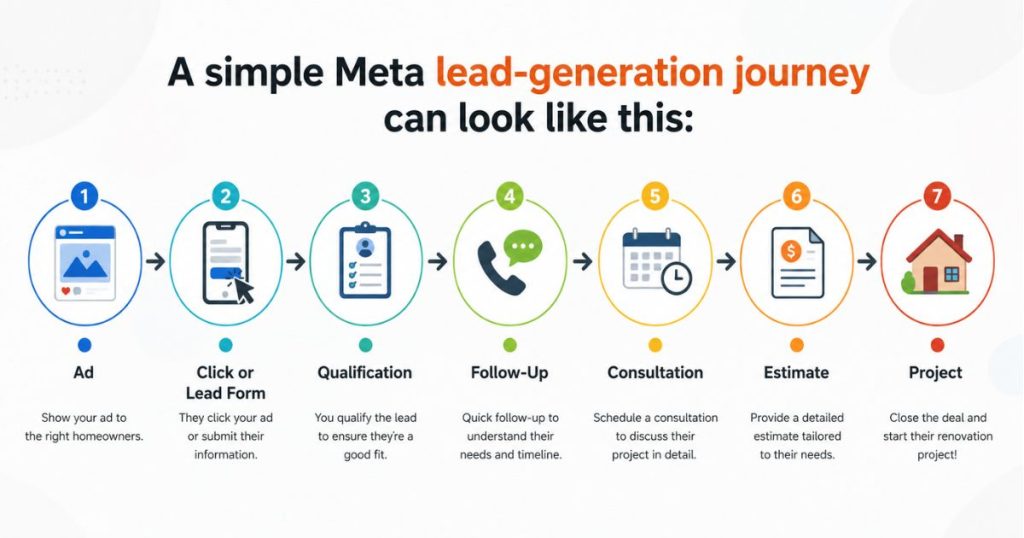
A simple Meta lead-generation journey can look like this:
Ad → Click or Lead Form → Qualification → Follow-Up → Consultation → Estimate → Project
The advertisement attracts attention.
The landing page or lead form collects information.
The contractor reviews the enquiry.
The sales team follows up.
A suitable prospect moves toward a consultation or estimate.
Eventually, some qualified opportunities become customers.
Every stage matters.
If the advertisement is strong but the form is confusing, conversion can suffer.
If the lead is good but nobody responds quickly, the opportunity can disappear.
If the contractor receives enquiries from outside the service area, time can be wasted.
This is why paid advertising should be treated as part of a complete lead generation process rather than as an isolated marketing activity.
Strategy 1: Define Your Ideal Homeowner
One of the first steps in any Meta campaign should be understanding who you want to reach.
A renovation contractor should identify the characteristics of an ideal customer.
Consider the type of projects you want, the communities you serve, the property types you work with, and the level of projects you are equipped to handle.
For example, a contractor specialising in high-end renovations should not necessarily use the same campaign strategy as a company focused on smaller renovation projects.
A contractor offering luxury home renovation services may want advertisements that emphasise design quality, craftsmanship, project management, premium finishes, and personalised service.
A contractor looking for basement projects may use a different message focused on creating additional living space.
The clearer the target customer, the easier it becomes to develop relevant advertising.
Strategy 2: Promote One Renovation Service at a Time
A common advertising mistake is trying to promote every service in one advertisement.
A message such as:
We provide kitchens, bathrooms, basements, additions, flooring, painting, decks, and
complete renovations.
may be accurate, but it does not give the homeowner a clear reason to respond.
A more focused campaign can be stronger.
For example:
Thinking About Finishing Your Basement?
The advertisement can then explain the service and encourage the homeowner to request more information.
Separate campaigns can be created for other services.
This approach is particularly useful for contractors looking for basement renovation leads, kitchen projects, luxury renovations, or custom renovation projects.
The more closely the advertisement matches the homeowner’s need, the easier it is for the person to understand what the contractor offers.
Strategy 3: Use Strong Visuals
Renovation advertising should show the work whenever possible.
Stock photographs may look professional, but real project photography can provide stronger credibility because homeowners can see what the contractor actually delivers.
Before-and-after images can be especially effective.
A contractor might show an outdated basement followed by the completed space.
A kitchen renovation advertisement could show the original layout and the finished kitchen.
A luxury renovation campaign could highlight detailed craftsmanship, custom cabinetry, premium finishes, lighting, and architectural features.
Video can also be useful.
A short project walkthrough can show more information than a single photograph.
The important point is authenticity.
Use genuine project images whenever possible and avoid presenting another company’s work as your own.
This is also an important part of E-E-A-T because real examples can help demonstrate experience.
Strategy 4: Create Lead-Focused Ad Copy
Good renovation advertising should answer the homeowner’s basic questions quickly.
The homeowner should understand:
What service is being offered?
Who is the service for?
Where is the service available?
What should the homeowner do next?
The advertisement does not need to explain the entire renovation process.
Instead, it should create enough interest for the homeowner to take the next step.
For example, a basement campaign could focus on transforming unused space into a practical living area.
A luxury campaign could focus on personalised design and high-quality workmanship.
A general renovation campaign could focus on helping homeowners plan and manage larger projects.
Avoid exaggerated claims such as guaranteed savings, guaranteed project values, or guaranteed results unless they can be properly supported.
Trust is more valuable than an aggressive sales message.
Strategy 5: Use Landing Pages That Match the Ad
Sending every Meta Ads visitor to the homepage can reduce the effectiveness of a campaign.
A homeowner who clicks an advertisement about basement renovations should ideally arrive on a page that discusses basement renovations.
The page should continue the same message introduced in the advertisement.
A good landing page should make the next step clear.
It can include:
- Service information
- Project examples
- Areas served
- Frequently asked questions
- Testimonials, where genuine
- A clear enquiry form
- Phone contact information
- A consultation or quote call to action
The page should also work well on mobile devices because many social media users access Facebook and Instagram from mobile phones.
The objective is to reduce friction.
A homeowner who is interested should be able to understand the service and contact the contractor without unnecessary steps.
Strategy 6: Qualify Leads Before the Sales Call
More leads are not always better.
A contractor receiving 50 enquiries that are outside the service area or unrelated to the services offered may have a bigger problem than a contractor receiving 10 relevant enquiries.
Lead qualification can help improve efficiency.
A renovation lead form can ask basic questions such as:
What type of renovation are you planning?
Where is the property located?
When are you hoping to start?
What stage is your project currently in?
What is the approximate project budget?
The exact questions should depend on the contractor and the service.
Do not make the form unnecessarily long.
The goal is to collect enough information to understand whether the enquiry is relevant.
This approach is particularly important when using lead services for contractors in Toronto, because lead quality should be evaluated based on actual business fit rather than raw volume.
Strategy 7: Retarget Interested Homeowners
Not every homeowner will contact a contractor the first time they see an advertisement.
Someone may click an advertisement, visit the website, look at project photographs, and leave.
That does not necessarily mean they are not interested.
Renovation decisions often take time.
Retargeting can help businesses reconnect with people who have already interacted with their website, advertisements, or social content, subject to Meta’s current policies and available audience options.
A retargeting campaign might show useful content rather than immediately asking for a sale.
For example:
Planning a Basement Renovation? Here Are 5 Things to Consider First.
This gives the homeowner another reason to return to the website.
The broader principle is important: renovation marketing should support the customer’s research journey.
Using Meta Ads for Basement Renovation Leads
Basement renovations can be an excellent campaign category because the transformation can be highly visual.
A contractor can use advertisements to show how an unfinished basement can become a useful living area.
Possible campaign themes include:
- Transform Unused Basement Space
- Create a Better Home Office
- Build a More Functional Family Space
- Turn Your Basement Into a Comfortable Living Area
The advertisement should match the contractor’s actual services.
If the company specialises in complete basement renovations, the landing page should explain the process from planning through completion.
If the contractor also works on basement suites, the content should clearly explain that requirements can vary by municipality and that permits, zoning, building codes, fire safety, and other regulations may apply.
This is an area where professional advice and accurate information are especially important.
Using Meta Ads for Luxury Home Renovation
Luxury renovation marketing requires a different approach from general lead generation.
High-value homeowners may look for quality, design, attention to detail, communication, project management, and confidence in the contractor.
A luxury home renovation advertisement should therefore focus on the experience and quality of the project rather than simply promoting a low price.
Visual quality matters.
Use high-resolution project photography and videos that demonstrate craftsmanship.
The landing page should also reinforce the positioning of the business.
For example, it could explain the company’s approach to design coordination, materials, project management, communication, and construction quality.
Avoid using “luxury” simply as a marketing word.
If a contractor markets luxury services, the website and customer experience should support that positioning.
Using Meta Ads for Custom Renovation Projects
Custom renovation projects often require a more consultative approach.
The homeowner may have a specific vision but may not know exactly how to achieve it.
The contractor’s job is to understand the property, needs, budget, design preferences, and project requirements.
Advertising can introduce the service, but the consultation is where the project can be properly explored.
Content for these campaigns can focus on:
- Unique layouts
- Personalised design
- Whole-home transformations
- Custom kitchens
- Custom storage
- Home additions
- Lifestyle-focused spaces
This type of advertising can attract homeowners who are looking for something beyond a standard renovation package.
Meta Ads and Marketing for Renovation Companies
Meta advertising works best when it is part of a wider strategy.
This is why marketing for renovation companies should not depend on one channel.
A strong digital strategy can combine:
SEO for long-term organic visibility.
Content marketing for homeowner education.
Meta Ads for awareness and targeted paid campaigns.
Google Ads for high-intent searches.
Email marketing for follow-up and nurturing.
Lead generation for additional opportunities.
Each channel can serve a different role.
For example, someone may first discover a renovation company through Instagram, later search its name on Google, read several website articles, view project photographs, and eventually submit an enquiry.
The customer journey is not always linear.
A strong brand presence across several channels can make the business easier to recognise and trust.
How Contractor Lead Generation Services Can Support Meta Ads
Paid social advertising is only one method of generating renovation opportunities.
Contractor Lead Generation Services in Mississauga can provide another source of potential customers while contractors continue developing their organic and paid marketing channels.
This can be especially useful for businesses that want to increase opportunities without depending entirely on social media advertising.
However, contractors should evaluate any lead generation provider carefully.
Ask important questions about:
- Where leads come from
- Which locations are covered
- What information is provided
- Whether leads are exclusive or shared
- How invalid leads are handled
- Which project types are available
- How leads are delivered
For contractors, relevance matters.
A lead for a small repair project may not be useful to a company specialising in large custom home renovation projects in Toronto.
Likewise, a homeowner looking for a service outside the contractor’s service area is unlikely to become a customer.
RenoLeadz focuses on helping renovation and home improvement businesses develop opportunities that align with their services and target markets.
The broader goal should be to build a predictable pipeline rather than chase every possible enquiry.
Common Meta Ads Mistakes Contractors Should Avoid
Using One Advertisement for Every Service
Different renovation services attract different homeowners. Create focused campaigns where appropriate.
Sending Every Visitor to the Homepage
A relevant landing page can make it easier for the visitor to understand the service and take action.
Focusing Only on Clicks
Clicks do not pay the bills. Track qualified leads, consultations, estimates, and completed projects.
Using Poor-Quality Images
Renovation is visual. Weak photography can make strong workmanship look less impressive.
Ignoring Lead Follow-Up
A good lead can lose interest if the business takes too long to respond.
Targeting Too Broadly
A large audience is not automatically a better audience. Focus on the homeowners and locations that fit the business.
Making Unsupported Claims
Avoid guaranteeing renovation costs, timelines, energy savings, property values, or investment returns without appropriate evidence.
How to Measure Meta Ads Performance
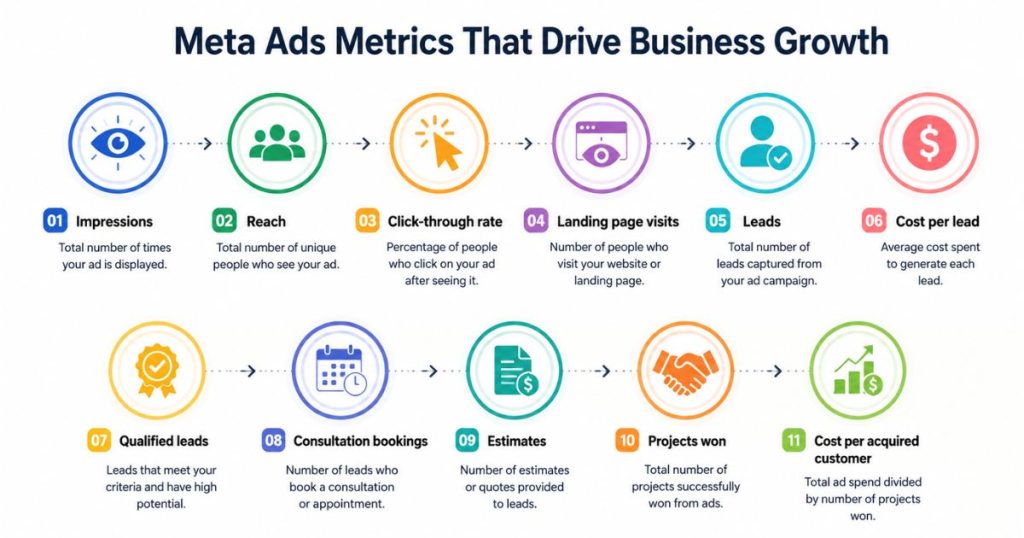
Contractors should look beyond basic advertising metrics.
Important metrics can include:
- Impressions
- Reach
- Click-through rate
- Landing page visits
- Leads
- Cost per lead
- Qualified leads
- Consultation bookings
- Estimates
- Projects won
- Cost per acquired customer
The most important measurement is ultimately business value.
For example, Campaign A may generate 40 leads at a low cost, but only two may become estimates.
Campaign B may generate 15 leads at a higher cost, but six may become estimates, and two may become profitable projects.
Campaign B could be more valuable.
This is why Home Renovation Leads should be measured based on quality and business outcomes, not simply volume.
Conclusion
Meta Ads can give renovation contractors another way to reach homeowners and generate new business opportunities.
But successful advertising is about more than creating an attractive Facebook or Instagram advertisement.
Contractors need to understand their ideal customers, promote relevant services, use authentic project visuals, create clear landing pages, qualify enquiries, respond quickly, and measure results beyond clicks.
For businesses seeking Home Renovation Leads, the strongest approach is usually a combination of channels.
SEO can build long-term visibility.
Content can answer homeowner questions.
Social media can demonstrate completed work.
Paid advertising can create additional exposure.
Contractor Lead Generation Services can provide another source of opportunities.
Together, these activities can create a stronger and more consistent marketing system.
For renovation businesses, the objective should not be to generate the largest possible number of leads.
It should be to generate relevant opportunities that have a realistic chance of becoming consultations, estimates, and profitable projects.
RenoLeadz helps renovation and home improvement businesses strengthen their lead generation strategy by focusing on relevant opportunities and the needs of contractors.
If your renovation business is ready to build a more consistent pipeline, combining effective advertising with SEO, content, and professional lead generation can give your marketing strategy a stronger foundation.
FAQ
Are Meta Ads effective for renovation contractors?
Meta Ads can be effective for renovation contractors when campaigns are targeted to relevant homeowners, use strong project visuals, provide a clear offer, and connect to a simple lead-generation process.
How can Meta Ads generate Home Renovation Leads?
Meta Ads can introduce renovation services to relevant audiences and direct interested homeowners to a landing page or lead form. The contractor can then qualify and follow up with suitable enquiries.
Can Meta Ads generate basement renovation leads?
Yes. Basement renovation campaigns can use before-and-after images, project videos, and educational content to attract homeowners considering basement improvements.
Are Meta Ads suitable for luxury home renovation?
They can be. Luxury campaigns should focus on quality, craftsmanship, design, project experience, and relevant visuals rather than competing primarily on price.
How much should a renovation contractor spend on Meta Ads?
There is no universal advertising budget that works for every contractor. Budget depends on location, competition, project value, target audience, campaign objectives, lead quality, and sales conversion rates.
Start with a controlled test budget and measure qualified results before making significant increases.