Getting people to visit a contractor’s website is only the beginning.
The real opportunity starts when a homeowner decides to call, complete a form, request an estimate, or ask for a consultation.
For renovation companies, this action can be especially valuable because a website visitor may already be researching a significant project. They could be planning a kitchen renovation, finishing a basement, upgrading a bathroom, adding living space, or considering a complete home transformation.
Yet many contractor websites receive visitors without generating enough enquiries.
The problem is not always a lack of traffic.
Sometimes the website simply does not make the next step clear.
A homeowner may arrive from Google, look at a service page, browse a few photographs, and leave because they cannot quickly understand what the company offers, whether it serves their area, what the process looks like, or how to get started.
That is where conversion-focused website design becomes important.
The goal is not to pressure visitors into contacting a contractor. It is to give them enough relevant information, confidence, and clarity to take the next step when they are ready.
For contractors, improving Renovation Enquiries can therefore involve much more than adding another contact button.
It requires a complete journey from search to website to enquiry.
This guide explains practical ways renovation companies can turn more relevant website visitors into genuine enquiries while also supporting SEO, Home Renovation Leads, and long-term digital marketing growth.
What Are Renovation Enquiries?
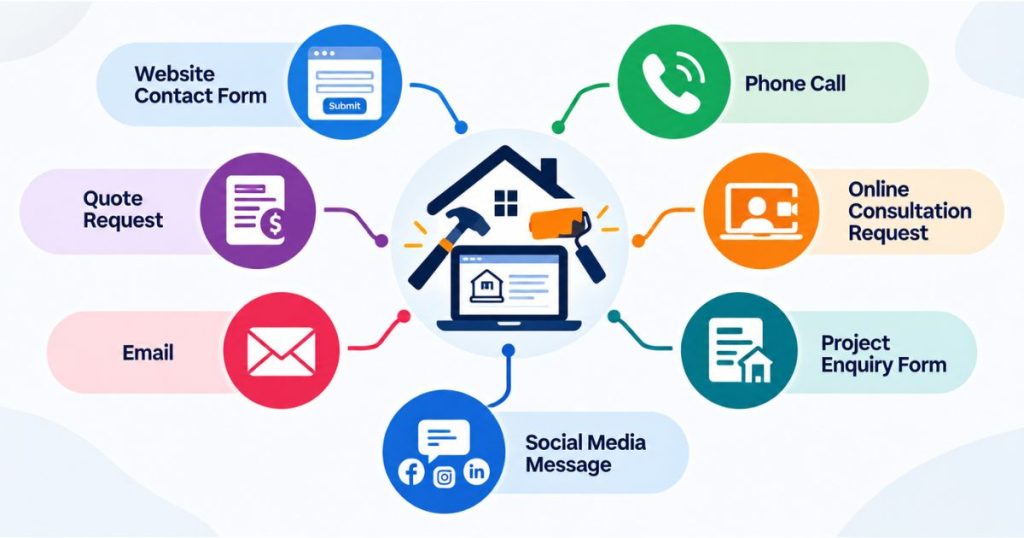
A Renovation Enquiry is an expression of interest from a homeowner or property owner about a renovation or home improvement project.
An enquiry might come through:
- A website contact form
- A phone call
- A quote request
- An online consultation request
- An email
- A project enquiry form
- A social media message
The important point is that an enquiry is more meaningful than a simple website visit.
A visitor is browsing.
An enquiry shows that the person has taken an action.
For example, someone searching Google for “kitchen renovation ideas” may still be researching.
Someone searching for “kitchen renovation contractor in Toronto” and completing a quote form is displaying a different level of commercial intent.
This is why contractors should consider search intent when building their website.
The objective is not to convert every visitor.
It is to make it easier for the right visitor to become an enquiry.
Why Website Traffic Does Not Always Create Leads
More traffic does not automatically mean more customers.
A contractor could receive thousands of monthly visitors but generate relatively few enquiries if those visitors are not relevant or the website does not communicate effectively.
There are several common reasons.
A website may attract people from outside the company’s service area.
A visitor may be looking for information rather than a contractor.
The service page may be too general.
The contact process may be difficult.
The website may not show enough evidence of previous work.
The call to action may be unclear.
Or the visitor may simply not understand what makes the contractor different.
This is why traffic and conversions need to be considered separately.
A healthy marketing strategy asks two questions:
Are the right people reaching the website?
Once they arrive, is the website helping them take the next step?
Both matter.
1. Match Your Website to Homeowner Search Intent
One of the simplest ways to improve Renovation Enquiries is to make sure your page answers the question behind the search.
Imagine a homeowner searches:
Basement renovation contractor near me.
They are probably looking for a service provider.
If they land on a generic homepage containing broad statements about construction, they may have to search for the basement service themselves.
A dedicated basement renovation page would be more relevant.
The page could explain the types of basement projects the contractor handles, the service area, the process, examples of previous work, and how homeowners can request an estimate.
The same principle applies to:
- Kitchen renovations
- Bathroom renovations
- Home additions
- Whole-home renovations
- Custom renovation projects
- Luxury home renovation
- Basement finishing
Each page should reflect the intent of the person who arrives there.
Google’s guidance recommends using the words people actually use to search for content in prominent and descriptive places, while focusing on helpful, people-first information rather than search-engine manipulation.
2. Make Your Service Pages Clear and Specific
A renovation website should make it immediately obvious what the business does.
A homeowner should not have to read five paragraphs before discovering whether the company handles their project.
Instead, the opening section of a service page should answer three basic questions:
What service do you provide?
Where do you provide it?
What should the homeowner do next?
For example, a basement renovation page could clearly introduce the company’s basement services, service area, project types, and consultation process.
The same structure can be used for kitchen, bathroom, addition, and whole-home renovation services.
This also supports SEO because descriptive page titles, headings, links, and content help Google understand what each page is about. Google specifically recommends descriptive, concise titles and warns against keyword stuffing.
3. Use Strong Calls to Action
A website visitor should never have to guess how to contact your business.
A call to action, or CTA, tells the visitor what they can do next.
Instead of using a generic button such as:
Submit
Consider using a clearer action:
- Request a Renovation Quote
- Book a Consultation
- Discuss Your Project
- Get a Project Estimate
- Start Your Renovation
The CTA should match the visitor’s stage in the decision process.
Someone reading an educational article may not be ready to request a quote immediately.
A softer CTA could be:
Talk to a Renovation Specialist
A visitor on a high-intent service page may be more comfortable with:
Request a Renovation Consultation
The key is clarity.
Do not fill every section of the page with aggressive sales messages.
Give the visitor useful information first, then provide an obvious next step.
4. Build Trust Before Asking for an Enquiry
Renovation projects involve money, time, access to someone’s home, and major decisions.
Homeowners therefore need a reason to trust a contractor before contacting them.
Your website can build trust by showing genuine evidence.
Useful trust elements can include:
- Real project photographs
- Clear service information
- Customer reviews
- Testimonials
- Contractor credentials
- Relevant experience
- Project galleries
- Service areas
- Clear communication about the renovation process
Real examples are particularly valuable.
If your company completed a kitchen renovation, show the actual project rather than relying entirely on generic stock photography.
Explain what the project involved and what problem the renovation addressed.
That provides context that a simple photograph cannot.
Google’s people-first guidance also encourages content that demonstrates first-hand expertise and provides original value rather than simply repeating information found elsewhere.
5. Make Your Website Easy to Use on Mobile
Many homeowners research renovation companies from their phones.
A website that works well on desktop but is difficult to use on mobile can create unnecessary friction.
Check the basic experience.
Can a visitor easily read the text?
Can they tap the phone number?
Can they see the CTA?
Can they complete the enquiry form without zooming?
Do project images load properly?
Can they move between service pages easily?
These details may appear small, but together they influence how easily someone can contact a business.
A conversion-focused website should make the next step simple on every screen size.
6. Simplify Your Enquiry Form
Long forms can discourage people from completing an enquiry.
A contractor may want to collect every possible detail immediately, but the first form does not necessarily need to ask for everything.
Start with information that helps determine whether the enquiry is relevant.
For example:
- Name
- Phone number
- Project type
- Location
- Brief project description
Depending on the business, additional questions about timing or approximate budget may also be useful.
The exact form should reflect how the contractor qualifies projects.
The important principle is balance.
You need enough information to understand the opportunity without creating unnecessary work for the homeowner.
7. Use Local SEO to Attract the Right Visitors
Local SEO for contractors is particularly important because renovation work is location-dependent.
A contractor may have an excellent website, but traffic from another province does not help if the company only works within a particular region.
Local SEO helps connect the website with the communities the contractor actually serves.
A local strategy can include:
- A complete Google Business Profile
- Location-specific service pages
- Accurate business information
- Genuine customer reviews
- Local project content
- Relevant internal links
- Location-focused service descriptions
For example, a contractor serving several communities in the Greater Toronto Area may develop useful pages for the markets that are genuinely important to the business.
However, location pages should not be created simply by changing a city name.
Each page should offer useful, locally relevant information.
This supports both users and search engines.
Google’s Search Essentials recommend creating helpful content, using words people search for in descriptive locations, and making internal links crawlable.
8. Create Dedicated Pages for High-Value Services
Not every renovation service should necessarily live on one generic “Renovations” page.
Dedicated service pages can provide a clearer experience.
For example:
- Kitchen Remodeling
- Bathroom Renovation
- Basement Renovation
- Home Additions
- Full Home Renovation
- Luxury Home Renovation
- Custom Renovation Projects
This structure gives each service its own space.
It also allows the contractor to answer specific questions that a homeowner may have before contacting the business.
For example, a luxury home renovation in Canada page could discuss design coordination, materials, custom features, project management, and the consultation process.
A basement page could focus on layouts, moisture considerations, living spaces, secondary-suite considerations, and project planning.
A custom renovation page could explain how design and construction decisions are handled when the project does not fit a standard package.
This is more useful than creating one page filled with every possible keyword.
9. Show Real Projects and Useful Proof
A renovation website should demonstrate what the contractor can actually do.
Project galleries can be particularly effective because renovation is a visual industry.
However, simply adding photographs is not enough.
Add context.
For each project, where appropriate, explain:
The homeowner’s goal
The work completed
The key design or construction considerations
The final result
For example:
A homeowner wanted to create a more functional basement living space. The renovation included improved lighting, flooring, storage, and a flexible entertainment area designed around the family’s daily use.
That is more informative than:
Beautiful basement renovation completed!
Original project information can also support E-E-A-T by demonstrating genuine experience.
If a contractor does not have permission to publish client details or photographs, obtain appropriate consent before using them.
10. Improve Your Follow-Up Process
Getting an enquiry is not the end of the process.
It is the beginning of the sales conversation.
A homeowner who submits an enquiry may contact several companies. A slow response can mean losing an otherwise relevant opportunity.
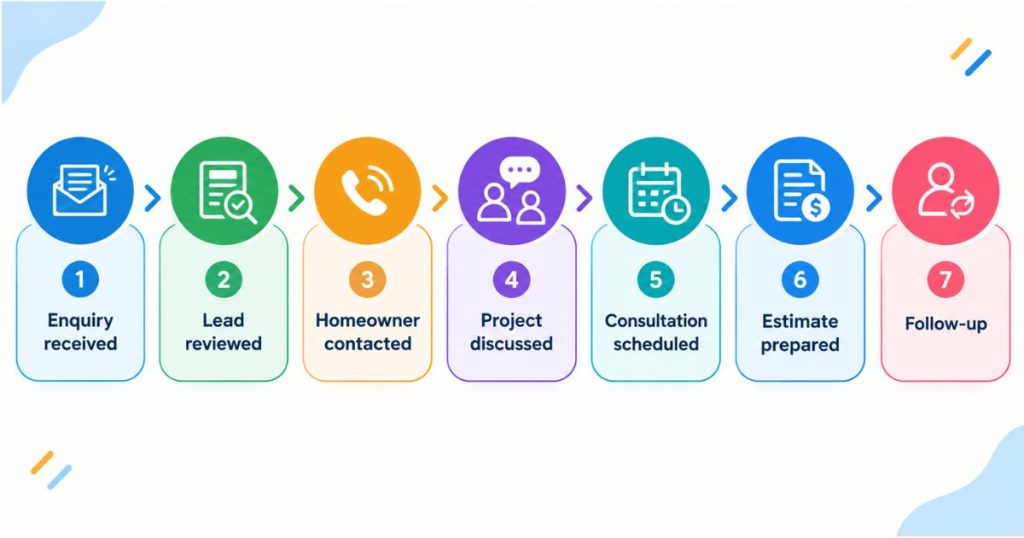
Contractors should have a clear process for handling new enquiries.
That process might include:
Enquiry received → Lead reviewed → Homeowner contacted → Project discussed → Consultation scheduled → Estimate prepared → Follow-up
The exact process will vary by contractor.
The important point is consistency.
Lead tracking can also help identify which marketing sources produce useful enquiries.
For example, a contractor may discover that website enquiries from a specific service page are more relevant than enquiries from a broad campaign.
That information can then guide future marketing decisions.
How Lead Generation for Home Services Fits Into the Strategy
Website conversion should not be viewed separately from lead generation.
Lead generation for home services is the broader process of attracting potential customers through channels such as:
- Organic search
- Local SEO
- Google Ads
- Social media
- Referrals
- Content marketing
- Lead generation platforms
Your website acts as the place where many of these visitors learn more about the business.
That means the website should support the entire marketing system.
For example, a homeowner might discover a contractor through a social media video, search the company name on Google, read a blog article, visit a service page, and then submit an enquiry.
The journey may take place across several channels.
A good website helps connect those touchpoints.
How Contractor Lead Generation Services Can Support Growth
Organic search can take time to build.
Paid advertising can require ongoing management.
Social media can build awareness but may not always produce immediate project enquiries.
This is one reason some contractors consider Contractor Lead Generation Services as part of their overall marketing mix.
The purpose is to create additional opportunities from homeowners actively looking for relevant services.
However, contractors should evaluate lead providers carefully.
Before purchasing lead services for contractors, ask questions such as:
- Where do the leads come from?
- Which locations are covered?
- What project information is provided?
- Are leads exclusive or shared?
- How are leads verified?
- How quickly are they delivered?
- What happens when a lead is invalid?
- How is lead quality measured?
There is no single lead model that fits every contractor.
A company specialising in large custom home renovation projects may have very different requirements from a contractor focused on smaller repairs.
The important thing is to understand what is being provided and whether it matches the business.
RenoLeadz states that its system uses targeted campaigns, area-specific targeting, custom lead funnels, lead filtering, phone verification, and direct lead delivery. Its website also lists renovation categories including kitchen, bathroom, basement, additions, and full-home renovation projects.
Basement Renovation Leads: Why Dedicated Pages Matter
Basement projects are a good example of why service-specific content can help.
A homeowner searching for basement renovation leads is not necessarily looking for a general contractor homepage.
They may want information about finishing a basement, creating an entertainment space, adding a home office, improving storage, or exploring a secondary suite.
A dedicated basement service page can address these questions.
It can also explain the contractor’s service area, process, previous projects, and consultation options.
The same principle applies to kitchen and bathroom renovation services.
Specific pages give visitors information that is much closer to their actual project.
Luxury Home Renovation Requires a Different Website Experience
A homeowner planning a luxury home renovation may evaluate a contractor differently from someone looking for a small repair.
The project can involve larger budgets, more detailed design decisions, premium materials, multiple trades, and longer timelines.
The website should reflect that level of service.
A premium renovation page might include:
- Detailed project photography
- Design and planning information
- Material examples
- Project management information
- Customisation options
- Previous project case studies
- Clear consultation process
The objective is not to make exaggerated claims.
It is to demonstrate capability through useful information and genuine evidence.
Marketing for Renovation Companies Should Connect Traffic With Conversion
Good marketing for renovation companies is not simply about getting more people to a website.
It is about attracting relevant people and helping them move forward.
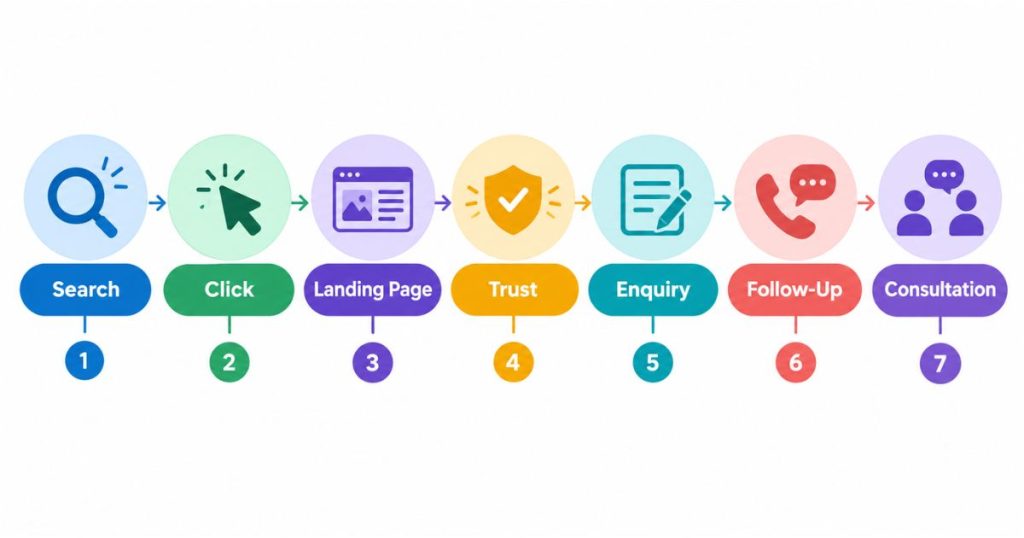
Consider the full journey:
Search → Click → Landing Page → Trust → Enquiry → Follow-Up → Consultation
If one stage is weak, the entire system can suffer.
For example:
If SEO brings traffic but the service page is unclear, visitors may leave.
If the service page is strong but the form is difficult, enquiries may be lost.
If enquiries are received but follow-up is slow, opportunities may disappear.
This is why marketing and conversion should be considered together.
How to Measure Renovation Enquiries
A contractor should measure more than website traffic.
Useful metrics include:
- Website visitors
- Service-page visits
- Enquiry volume
- Phone calls
- Form submissions
- Qualified enquiries
- Consultation bookings
- Estimates
- Closed projects
- Cost per enquiry
- Cost per qualified lead
- Lead-to-customer conversion rate
The most useful metric depends on the business.
For example, 100 enquiries are not necessarily better than 30 if the 30 enquiries are more relevant and produce more consultations.
Track the entire journey whenever possible.
This helps distinguish between traffic problems and conversion problems.
Common Website Conversion Mistakes Contractors Should Avoid
Using a Generic Homepage for Every Service
A homeowner looking for a basement renovation should not have to search through a general construction website to find the relevant service.
Create clear service pathways.
Hiding Contact Information
Your phone number and enquiry options should be easy to find.
Using Too Many CTAs
Too many competing buttons can make the page feel confusing.
Choose one primary action for each page.
Relying Only on Stock Photos
Real project images can communicate genuine experience more effectively when permission has been obtained.
Making Unsupported Claims
Avoid claims such as “best contractor,” “guaranteed results,” or specific financial returns unless you have evidence that supports them.
Trust grows through proof, not exaggeration.
Ignoring Existing Customers
Customer reviews and genuine project stories can provide useful evidence for future visitors.
Focusing Only on Rankings
A page can attract search traffic but still fail to generate useful enquiries.
The purpose of SEO should ultimately be to help the right audience find useful information and take an appropriate next step.
Conclusion
Turning website visitors into Renovation Enquiries starts with understanding what homeowners need when they arrive on your website.
They want clear information.
They want to know whether you provide the service they need.
They want to see evidence of your work.
They want to know whether you serve their area.
And when they are ready to talk, they need an easy way to contact you.
A strong conversion strategy brings these elements together.
The key steps are:
- Match content with search intent.
- Build clear service pages.
- Use relevant calls to action.
- Demonstrate genuine experience.
- Make the website mobile-friendly.
- Keep enquiry forms simple.
- Strengthen Local SEO for contractors.
- Build dedicated pages for important services.
- Use real project evidence.
- Follow up consistently.
SEO and conversion should work together.
Local search can bring relevant homeowners to the website. Helpful content can answer their questions. Service pages can explain what the contractor provides. Trust signals can reduce uncertainty. A simple enquiry process can make the next step easier.
For contractors looking for additional opportunities, Contractor Lead Generation Services and other forms of lead generation for home services can complement the website’s organic marketing strategy.
RenoLeadz focuses on connecting contractors with homeowner enquiries for renovation and home improvement services, including kitchen, bathroom, basement, additions, and full-home renovation projects.
The objective should not be to turn every visitor into a lead.
It should be to create a website that helps the right homeowner move from research to a meaningful conversation with the contractor.
FAQ
How can I get more Renovation Enquiries from my website?
Start by attracting relevant visitors through SEO and other marketing channels, then improve your service pages, calls to action, enquiry forms, trust signals, mobile experience, and follow-up process.
What is the difference between website traffic and Renovation Enquiries?
Website traffic represents people visiting your website. A Renovation Enquiry is an action such as a phone call, form submission, email, or consultation request from someone interested in a renovation service.
Does Local SEO for contractors help generate enquiries?
Yes, local SEO can help contractors become more visible to people searching for services in their target areas. The website still needs relevant service information and a clear conversion path.
How important are landing pages for renovation companies?
Landing pages help visitors quickly understand a particular service. A dedicated page for kitchens, bathrooms, basements, additions, or custom renovation projects can be more relevant than sending every visitor to a generic homepage.
What should a renovation enquiry form ask?
A basic form can request a name, contact information, location, project type, and short project description. Additional questions about timing or budget can be added if they are useful for the contractor’s qualification process.