
Running a contracting business is about much more than completing quality projects.
You also need a steady flow of homeowners who know your company, trust your work, and are willing to contact you when they are ready to renovate.
That is where social media can become a useful business tool.
For contractors, platforms such as Instagram, Facebook, YouTube, and LinkedIn are not simply places to post attractive renovation photographs. Used properly, they can help explain your services, demonstrate your workmanship, answer homeowner questions, and keep your company visible throughout the renovation decision-making process.
The important word is properly.
Posting once every few weeks and expecting enquiries to appear is unlikely to produce consistent results. A strong social strategy connects content with the services you sell and the customers you want to reach.
For example, a contractor specialising in kitchens should not only post finished kitchens. The company can also explain kitchen planning, material choices, common mistakes, project timelines, budgeting considerations, and design decisions.
A basement contractor can explain the planning process behind a finished basement.
A company handling luxury home renovation can demonstrate craftsmanship, materials, project management, and attention to detail.
And a contractor working on custom renovation projects in Toronto can show how challenging spaces are transformed into practical living areas.
This article covers seven social media moves that can help contractors turn social platforms into a meaningful part of their growth strategy.
Why Social Media Matters for Contractors
Renovation decisions are rarely made instantly.
A homeowner may spend weeks or months researching ideas, comparing contractors, reviewing photographs, reading reviews, and discussing budgets before contacting a company.
Social media allows contractors to remain visible during this process.
A homeowner who sees a contractor’s project today may not be ready to renovate until several months later. Consistent content helps keep that contractor familiar when the homeowner eventually starts looking for estimates.
Social media can also support other digital marketing channels.
A homeowner might first discover a contractor through Google, then check Instagram before contacting the company. Another person might see a renovation video on Facebook and later search for the business by name.
This is why social media should not be treated as a completely separate marketing activity.
It should work alongside SEO, content marketing, paid advertising, website conversion, and Contractor Lead Generation Services in Toronto.
Move #1: Show the Work, Not Just the Advertisement
The first social media move is simple: show people what you actually do.
Homeowners want evidence.
Instead of constantly publishing posts that say, Contact us for a renovation, demonstrate the quality of your work.
Show completed rooms, construction details, material choices, progress photographs, and before-and-after transformations.
A strong project post can explain what the homeowner wanted, what problem the renovation needed to solve, what work was completed, and what the finished result achieved.
For example:
This outdated kitchen had limited storage and poor lighting. The renovation introduced additional cabinetry, improved task lighting, and a more functional layout.
That provides considerably more information than:
Another beautiful kitchen completed!
The first example tells a story.
It also gives potential customers an idea of how your company approaches renovation work.
When possible, use original photographs and videos from real projects. Authentic content is generally more useful than generic stock images because it demonstrates experience.
This is particularly valuable when promoting Home Renovation Leads because homeowners can see evidence of the services behind the marketing.
Move #2: Turn Projects Into Educational Content
Every renovation project contains useful information.
Contractors often overlook this because construction knowledge becomes second nature to them.
Homeowners, however, may have never managed a renovation before.
That creates an opportunity.
Instead of simply showing the finished project, explain what happened behind it.
A kitchen renovation could become a post about layout planning.
A basement project could become an explanation of moisture considerations, insulation, lighting, or space planning.
A bathroom renovation could become content about ventilation, waterproofing, storage, or material selection.
This type of educational content supports lead generation for home services in Mississuaga because it answers questions that homeowners are already likely to have.
It also helps demonstrate expertise.
A contractor does not need to reveal every technical detail. The goal is to explain important decisions in clear, simple language.
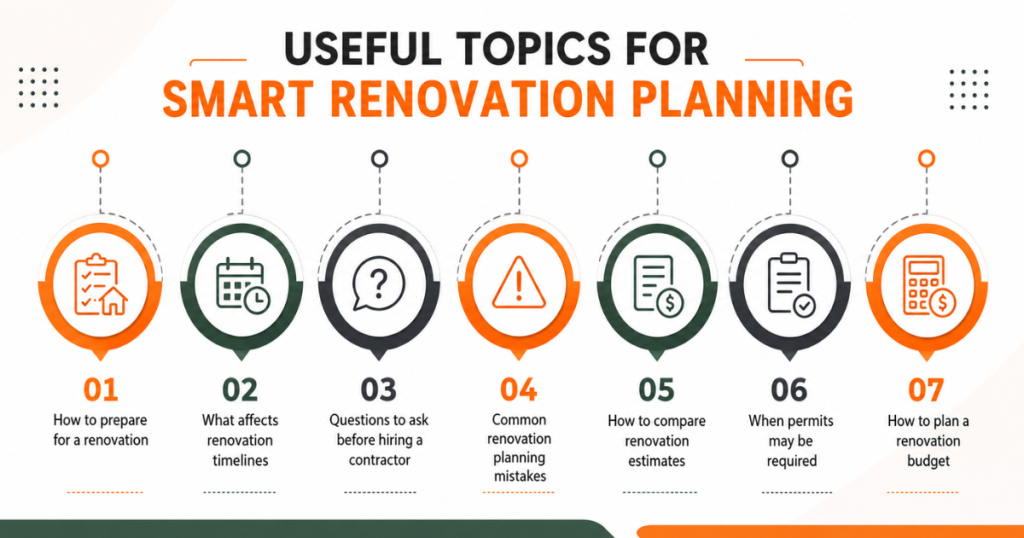
Useful topics include:
- How to prepare for a renovation
- What affects renovation timelines
- Questions to ask before hiring a contractor
- Common renovation planning mistakes
- How to compare renovation estimates
- When permits may be required
- How to plan a renovation budget
Educational content can also become website content later.
One social media topic can lead to a blog article, video, email, infographic, or FAQ.
That gives your marketing investment a longer life.
Move #3: Use Video to Build Familiarity and Trust
Video can help homeowners see the people and processes behind a contracting business.
You do not need expensive production equipment.
A smartphone can be enough for simple project walkthroughs, short explanations, progress updates, and team introductions.
Consider creating videos such as:
- 60-second kitchen renovation walkthrough.
- Three things homeowners should decide before a basement renovation.
- What happens during the first renovation consultation?
- Before and after: transforming an outdated bathroom.
- A day on a renovation project.
The goal is not to make every video go viral.
The goal is to provide useful information while allowing potential customers to become familiar with your business.
This can be especially valuable for luxury home renovation and custom renovation projects, where homeowners may want confidence in a contractor’s process before discussing a major project.
Keep videos focused.
Start with the question or problem.
Explain the answer.
Finish with a natural next step.
Avoid turning every video into a hard sales pitch.
Move #4: Make Local Content a Priority
Contracting businesses are usually location-dependent.
A renovation company may serve specific cities, communities, or service areas. That means your social media content should reflect where you actually work.
Instead of creating completely generic posts, occasionally mention the communities and markets your company serves.
For example:
We recently completed this basement transformation for a homeowner in..
Or:
Here are three considerations for homeowners planning a kitchen renovation in..
Local content can help reinforce your connection to a market.
It can also work alongside local SEO for Contractors.
Your website may target searches for renovation services in specific cities, while social media demonstrates that your business is active in those communities.
However, avoid pretending to have experience in an area if you do not actually serve it.
Trust matters.
If a contractor publishes local content, it should be based on genuine service areas, real projects, or useful local information.
This approach supports marketing for renovation companies by making the business feel relevant rather than generic.
Move #5: Use Social Media to Support Your Lead Funnel
Social media should have a clear relationship with your website.
A social post may create interest, but your website usually provides the deeper information needed before a homeowner submits an enquiry.
Think of the journey like this:
Social Media → Website → Information → Trust → Enquiry → Consultation → Estimate
A contractor can use social media to introduce a topic and direct interested homeowners to a useful website page.
For example, an Instagram post about basement renovation could link people toward a detailed basement service page.
A video about kitchen planning could direct homeowners to a kitchen renovation guide.
A post about custom renovation work could lead to a page explaining your design and construction process.
This creates a connected marketing system.
Your social media content attracts attention.
Your website provides information.
Your lead form or phone number creates the opportunity.
Your follow-up process moves the potential customer toward a consultation.
This is one reason social media should be connected to your broader Contractor Lead Generation Services strategy rather than treated as an isolated activity.
Move #6: Turn Customer Experiences Into Social Proof
Homeowners want to know whether they can trust a contractor.
Your completed projects demonstrate what you can build.
Customer experiences demonstrate what it is like to work with you.
With the customer’s permission, share genuine testimonials, project stories, or short interviews.
Instead of publishing only:
5-star review from a happy customer!
provide some context.
Explain what type of project was completed and what the customer appreciated.
For example:
The homeowner wanted to create a more functional main-floor layout. The project included a redesigned kitchen, improved storage, and updated lighting.
Then include the customer’s genuine feedback if permission has been provided.
Do not invent testimonials.
Do not modify customer comments in a way that changes their meaning.
And do not publish personal information without appropriate consent.
Authentic social proof can support lead services for contractors because potential customers can see evidence of previous customer experiences.
It also contributes to E-E-A-T by demonstrating real-world experience.
Move #7: Measure Leads, Not Likes
Likes and followers can be useful indicators of engagement, but they are not the final business objective.
A contracting company needs customers.
That means your social media strategy should be connected to measurable business outcomes.
Track metrics such as:
- Website visits from social media
- Phone enquiries
- Form submissions
- Qualified leads
- Consultation requests
- Estimates
- Projects won
- Cost per qualified lead
For example, suppose one post receives 500 likes but produces no enquiries.
Another post receives 50 interactions but sends 10 qualified homeowners to your website.
The second post may be considerably more valuable to the business.
This is why contractors should evaluate social media based on its contribution to the sales process.
When possible, use tracking links, analytics, CRM records, and lead-source questions to understand where enquiries originated.
Over time, you can identify which topics, platforms, formats, and campaigns generate the strongest opportunities.
That information can then improve your lead generation for home services strategy.
Social Media Content Ideas for Contractors
Contractors do not need to reinvent their content every day.
One completed project can produce several pieces of useful content.
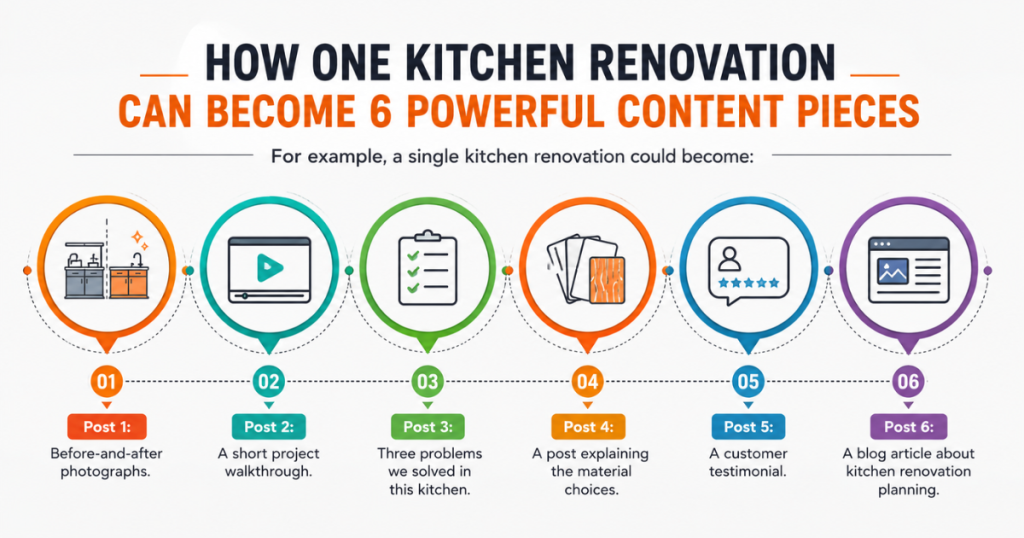
For example, a single kitchen renovation could become:
Post 1: Before-and-after photographs.
Post 2: A short project walkthrough.
Post 3: Three problems we solved in this kitchen.
Post 4: A post explaining the material choices.
Post 5: A customer testimonial.
Post 6: A blog article about kitchen renovation planning.
This approach is more sustainable than trying to create completely new ideas every day.
Other useful content categories include:
Educational Content
Explain renovation decisions homeowners may not understand.
Project Content
Show real work and explain the transformation.
Team Content
Introduce the people responsible for planning and completing projects.
FAQ Content
Answer questions that frequently come up during consultations.
Behind-the-Scenes Content
Show planning, preparation, construction, and finishing work.
Local Content
Highlight genuine projects and activity within your service areas.
The best content mix depends on your business and audience.
How Social Media Fits Into Lead Generation for Home Services
Social media rarely needs to carry your entire marketing strategy.
It works better as one part of a larger system.
For example:
SEO helps homeowners discover your website through search.
Content marketing answers their renovation questions.
Social media builds familiarity and distributes useful content.
Paid advertising can target specific audiences and services.
Landing pages provide focused information.
Lead generation creates enquiries.
Sales follow-up converts opportunities into consultations and projects.
This is the broader picture of lead generation for home services.
A contractor should not ask only, “How many followers do we have?”
A better question is:
Is our marketing helping the right homeowners discover us and take the next step?
Common Social Media Mistakes Contractors Should Avoid
Posting Only Promotional Content
If every post asks people to hire you, your audience may stop paying attention.
Balance promotional content with useful information.
Buying Followers
Large follower numbers do not guarantee qualified customers.
Focus on relevant audiences and genuine engagement.
Using Only Stock Images
Stock photographs do not demonstrate your actual workmanship.
Use original project photography whenever possible.
Ignoring Comments and Messages
Social media is a communication channel.
Respond professionally and promptly when potential customers ask legitimate questions.
Chasing Every Trend
Not every social trend makes sense for a contracting business.
Choose formats that help communicate your expertise.
Forgetting the Website
Social media should have somewhere useful to send interested homeowners.
Make sure your website has relevant service pages and clear contact options.
Measuring Vanity Metrics Only
Followers and likes are not enough.
Track enquiries, qualified leads, consultations, estimates, and projects.
How RenoLeadz Can Support Contractor Growth
A successful contracting business needs more than social media activity.
It needs a reliable way to attract homeowners who are actively interested in renovation services.
This is where RenoLeadz can support contractors through a broader digital marketing and lead-generation strategy.
RenoLeadz focuses on SEO, social media marketing, and lead generation for renovation and home improvement businesses.
The objective is to connect online marketing activity with real business opportunities.
For contractors, this may include building visibility around services such as kitchen renovations, basement renovations, home additions, luxury home renovation, and custom renovation projects.
The right strategy depends on the contractor’s service area, ideal customer, project type, budget, capacity, and business goals.
A good marketing strategy should therefore begin with understanding the business rather than simply choosing a platform.
Conclusion
Social media can become a valuable growth channel for contractors when it is treated as part of a complete marketing system rather than simply a place to post photographs.
The seven moves are straightforward:
- Show the work, not just advertisements.
- Turn completed projects into educational content.
- Use video to build familiarity and trust.
- Make local content part of your strategy.
- Connect social media with your website and lead funnel.
- Use genuine customer experiences as social proof.
- Measure leads and business results, not just likes.
The biggest opportunity is consistency.
A contractor that regularly demonstrates expertise, answers homeowner questions, shares real projects, and makes it easy to take the next step can build a stronger digital presence over time.
Social media alone may not solve every lead-generation challenge.
But when combined with SEO, website content, local search, paid campaigns, strong landing pages, and Contractor Lead Generation Services, it can become an important part of a predictable growth system.
For renovation companies, the objective should always be bigger than gaining followers.
The real goal is to become visible, trusted, and easy to contact when a homeowner is ready to start a project.
That is the foundation of effective marketing for renovation companies and a stronger long-term approach to generating Home Renovation Leads.
Frequently Asked Questions
Is social media effective for contractors?
Yes. Social media can help contractors demonstrate completed work, educate homeowners, build familiarity, share customer experiences, and direct interested people to their websites.
However, results depend on content quality, consistency, audience targeting, follow-up, and how social media fits into the wider marketing strategy.
Which social media platform is best for contractors?
There is no universal best platform. Instagram can work well for visual project content, Facebook can be useful for local audiences and community engagement, YouTube can support longer educational videos, and LinkedIn can be valuable for professional networking and business-to-business relationships.
The best platform depends on where your target customers spend time.
Can social media generate Home Renovation Leads?
Yes. Social media can generate direct enquiries and can also contribute indirectly by increasing brand awareness and sending potential customers to a contractor’s website.
How often should a contractor post on social media?
Consistency is generally more important than posting an excessive amount of content. A contractor should choose a realistic schedule that can be maintained while keeping content useful and relevant.
What should contractors post on social media?
Contractors can post completed projects, before-and-after transformations, educational tips, renovation FAQs, videos, customer stories, team introductions, behind-the-scenes content, and local project updates.